This year has been vibrant for physics research; scientists of various sub disciplines have uncovered many unknowns, from the discovery of single naked black holes to the invention of 2D metallic sheets. These works will inspire further discoveries in the coming year. Here, I have tried to highlight five such widely discussed works.
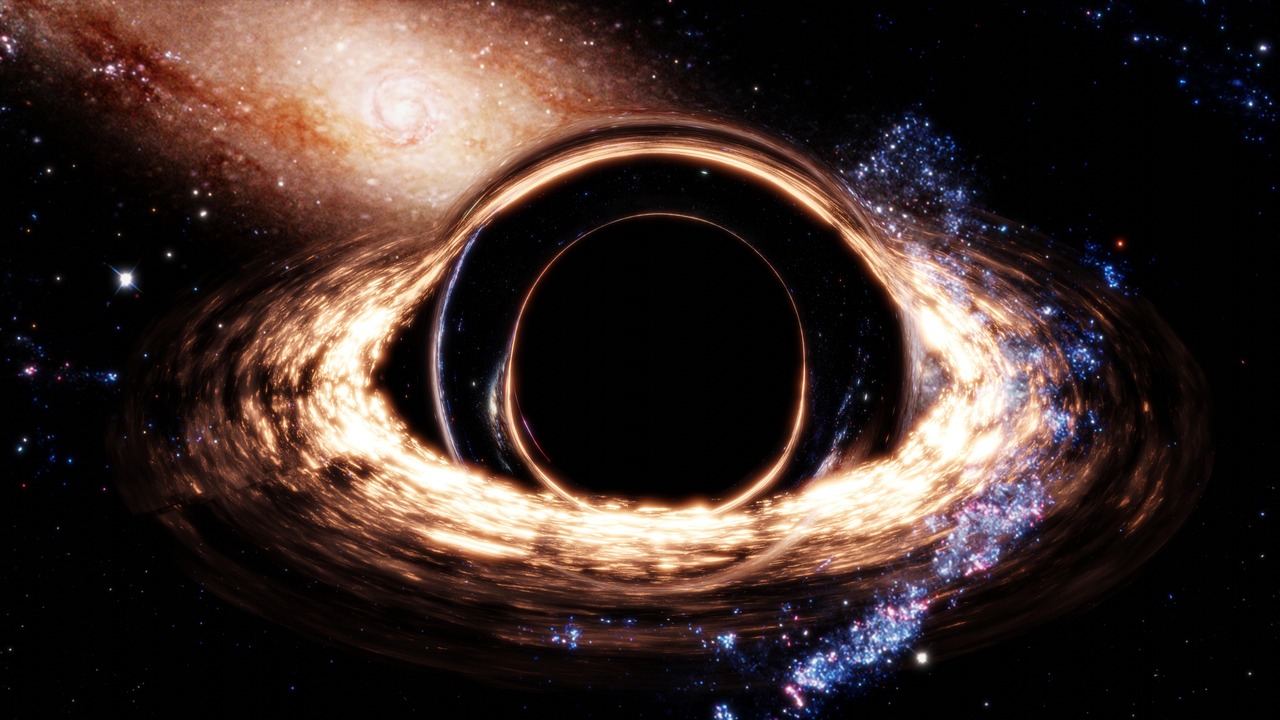
1. Single Naked Black Hole
Scientists have been observing the sky with binoculars since ancient times. With the passage of time, they have come up with powerful telescopes like Hubble and James Webb, which have captured images of the baby universe at different times. Thus, the secrets of cosmic events from the universe's first 100 million years are being uncovered. Recently, JWST's mirror detected a series of mysterious tiny red dots of light. One of those red dots is actually a naked black hole, the mass of which is about five million suns!

Naked black hole ( Credit:NASA)
Usually, such supermassive black holes are at the center of the galaxy. However, no galaxies were found to exist around the black hole like the red dot. Only a thin layer of gas covers it.
This naked black hole has changed a lot of the idea related to the baby universe. Scientists have long believed that galaxies first form, and then the massive stars in them turn into black holes of different sizes. Again, the smaller ones combine to form the giant one. But this discovery has put the idea to rest. Now the question is, how did such a black hole form in the infant universe? Was this black hole formed during the Big Bang? We still don't know the answer to that question, but it's one that astronomers are grappling with.
2. Dark energy
There is no end to people's curiosity about dark energy and dark matter. The Dark Energy Spectroscopic Instrument (DESI), located on Mount Palomar in Arizona, has played a major role in this research. Based on the data collected with the help of this state-of-the-art telescope led by the Berkeley National Laboratory, DESI released a map of the universe in March of 2025, which contains information on about 15 million galaxies. By analyzing such a large amount of data, scientists have found that the foundation of dark energy is becoming increasingly weak.
For the past few decades, we have known that the universe has been expanding since 10??³ seconds after the Big Bang. To explain the acceleration of the universe, scientists came up with the concept of 'dark energy.' It was thought to work against gravity, pushing the universe away. But recently, researchers at Yonsei University in South Korea challenged the Nobel-winning theory, claiming that the expansion rate of the universe is slowing down, which is 180 degrees contrary to the conventional idea! The establishment of this theory means that over time, the density of dark energy will decrease.
Dark energy is the energy of the universe. But where this energy comes from and why it is so widespread—scientists have not yet found clear answers to these questions. Now if we really see that the density of dark energy is decreasing every 100 billion years, then our understanding of the universe can be radically changed.
3. 2-D metal sheet
A group of scientists at the Physics Institute of the Chinese Academy of Sciences, for the first time, created a two-dimensional sheet made of metal, i.e., it has only length and width, but not height. For this work, the researchers heated and melted pure metal powder between two layers of molybdenum disulphide and sapphire anvil. They then applied high pressure to produce extremely thin metallic two-dimensional sheets of bismuth, tin, lead, indium, and gallium.

Schematic diagram of 2D metallic sheet ( Credit: Chinese Academy of science)
Attempts to create 2D plates are not new in the history of physics—the first graphene was created in 2004. It was actually a 2D object. Since then, scientists have created many 2D objects. However, similar to graphene, these do not possess metallic properties. It was very difficult for scientists to create metallic 2D objects. This difficulty stems from the fact that each atom in a metal is surrounded by numerous atoms. This year, Chinese scientists have made that impossible.
4. Highest resolution image of an atom
In experimental physics, or astrophysics, images are crucial. However, the production of images suitable for complex calculations in theoretical physics was a surprise to many. In 2025, a team of scientists led by I. Zhang of the University of Maryland and P. Huang of the University of Illinois took a new image of a single atom. This is the highest resolution image so far.

electron ptychographic reconstruction of a praseodymium orthoscandate (PrScO3) crystal, zoomed in 100 million times (Credit: Cornell University)
The scientists used an advanced electron microscopy technique called electron ptychography to capture the images. With this, they have taken pictures of 15-picometer resolution. The smaller the resolution, the better the picture. For example, the more megapixels the camera has, the smaller the image can be divided into pixels. So the picture quality is good. 15 picometers is about one-tenth the size of an atom. This picture allows us to see the inner structure of the atom.
In this work, the researchers used a compound called tungsten diselenide. They separated two very thin atoms of this compound. Then the two layers are laid out slightly twisted relative to each other. As a result, a special design is created. This is called moiré superlattices. By changing the angle of rotation of these superlattices, there is a big change in their electrical properties, which makes it easier to take pictures. Using fine resolution, the researchers found a kind of collective vibration inside the superlattice. They are called "Moiré phonons. They are similar to phonons, which are proposed quantum particles for sound waves. The existence of the moiré phonon was theoretical but had not been directly seen for so long. This is the first time researchers have been able to visualize it with the help of new images.
There was a time when it was impossible to photograph an atom separately. It was almost impossible to capture with an electron microscope. But once upon a time, scientists were able to take pictures of atoms. From that perspective, this picture will be of enormous help to theoretical physicists, especially in understanding the role of vibration in other lattices, including the Moiré phonons. Scientists think these images will help create new compounds for future use.
5. Quantum control of antiprotons
This year, physicists at CERN performed integrated spin spectroscopy on a single antiproton for the first time. An antiproton is the antiparticle of a proton. This study has made it possible to measure the magnetic properties of antiprotons in the most accurate way so far. These particles can be used to test the Standard Model of physics.

Exquisite control Physicist Barbara Latacz at the BASE experiment at CERN. (Courtesy: CERN)
In this experiment, very high-energy antiprotons were first created in an accelerator device. They are then lowered to the cryogenic stage (below -150 ° C). Scientists have to take care that the antiparticles do not become destroyed while cooling at such a low temperature. Then a single antiproton is trapped in an extremely cold electromagnetic environment. There its spin is controlled with the help of microwave waves.
The maximum amplitude of the vibration found in this experiment is 16 times narrower than any previous measurement. With such a high degree of quantum control, it will be possible to compare the properties of electrons, protons, and antiparticles very finely. If there is an unexpected difference, the calculation can be changed. Then perhaps a new theory beyond the standard model of particle physics can be found. The study may also explain why the visible universe has more matter than antimatter.